It is often surprising how many organizations operate without a formal strategic plan. To be clear, most organizations are not lacking activity; they have targets, goals, KPIs, and revenue benchmarks. What is frequently missing, however, is a coherent strategy that aligns those efforts to a shared vision. Instead, many organizations default to doing what they have always done, only more efficiently, more urgently, or with greater intensity. While this approach may produce short-term results, it rarely produces sustained impact or long-term differentiation.
A strategic plan serves a fundamentally different purpose. It helps an organization keep the main thing the main thing by providing directional focus and discipline around decision-making, ensuring that actions taken today align with the future the organization has intentionally chosen. Without this anchor, organizations risk prioritizing what feels urgent or comfortable in the moment rather than what is necessary to fulfill their mission and vision.
Equally important, a strategic plan creates accountability. It moves the organization beyond isolated goals and toward a shared framework for execution. When strategy is clear, progress can be evaluated not only through outputs but also by whether the organization is advancing toward desired outcomes. This level of clarity allows leaders to steward resources more effectively and make informed decisions when trade-offs inevitably arise.
Strategic planning also plays a critical role in employee engagement. People want to understand where the organization is headed and how their work contributes to that direction. A well-crafted strategic plan provides employees with a sense of purpose and connection, linking individual roles to broader organizational priorities. When staff understand how their contributions matter, engagement deepens, and accountability becomes shared rather than imposed.
Some organizations do experience success without a formal strategic plan, at least for a period. Often, that success is driven by sweat equity, intuition, or the ability to quickly respond to industry trends. While these factors can be valuable, they are not substitutes for strategy. Relying solely on trends often positions organizations as followers rather than leaders, and intuition—no matter how effective—becomes increasingly difficult to scale as complexity grows.
Importantly, strategic planning not only clarifies direction but can also positively impact financial performance. When an organization thoughtfully aligns resources that include time, talent, and capital to its strategic priorities, it reduces waste and improves efficiency, positioning itself to allocate funds where they have the greatest impact. Strategic planning helps leaders anticipate future needs, optimize budgeting, and proactively manage performance, all of which can contribute to enhanced profitability and stronger financial results over time. Strategic realignment of resources ensures that investments are tightly aligned with strategic goals, improving cost-effectiveness and return on investment.
Ultimately, a well-designed strategic plan provides clarity, purpose, and traction. For organizations seeking not just incremental improvement but transformational growth, strategy becomes essential. It is the difference between striving for modest gains and positioning the organization to move from 2x to 10x.
Effective Strategic Planning–The IMAN Way
At IMAN Consulting, strategic planning is grounded in the SOAR methodology: Strengths, Opportunities, Aspirations, and Results. This framework shifts the conversation from deficits to possibilities, allowing organizations to build on what is working while clearly articulating their desired future. SOAR emphasizes shared success by asking stakeholders not only what they aspire to achieve, but how success will be defined and measured. Beginning with results in mind creates greater ownership and accountability across the organization.
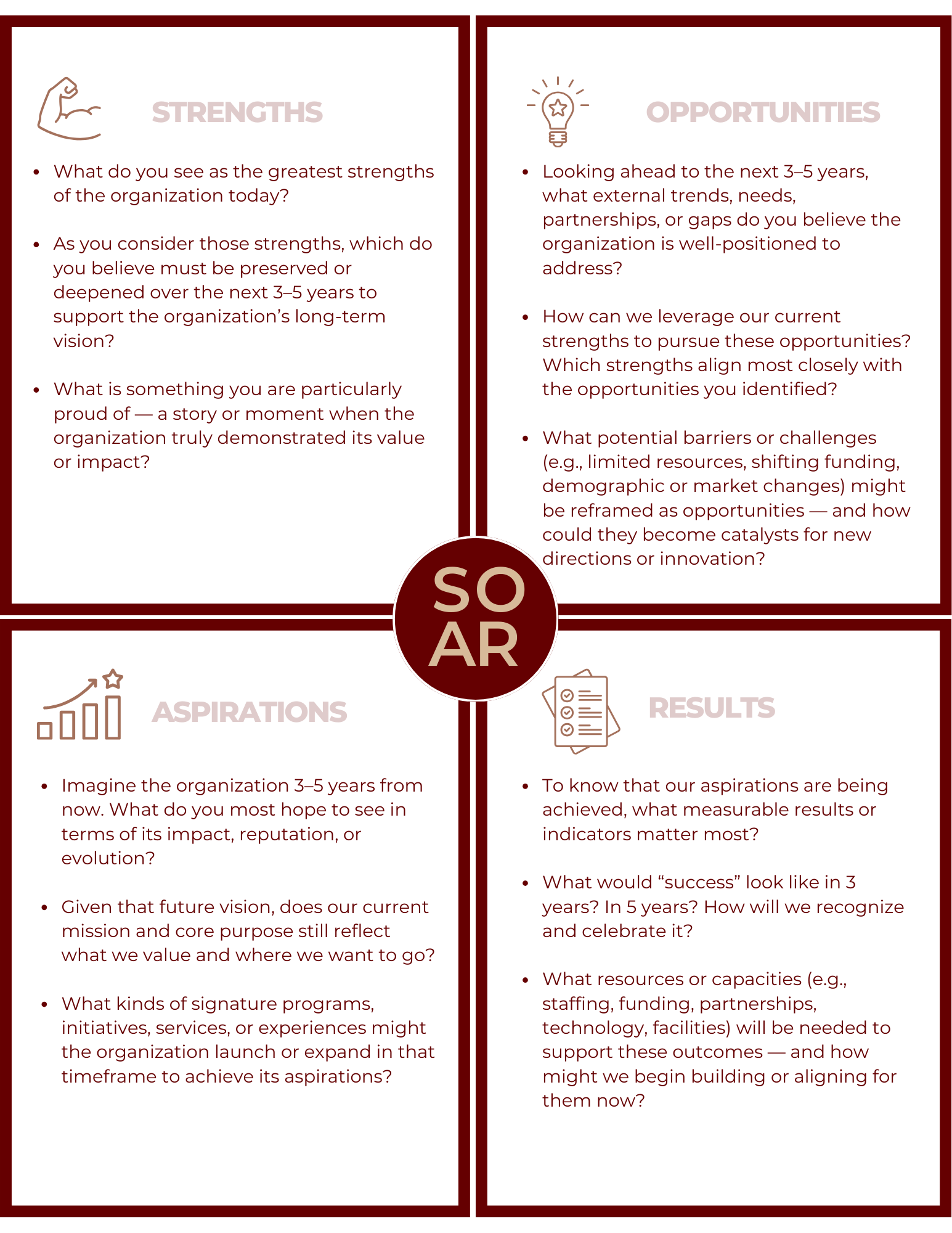
A rigorous strategic planning process also requires thoughtful engagement with stakeholders. At IMAN Consulting, we not only conduct an organizational audit to evaluate an organization’s profile, employee satisfaction, financial performance, and much more, but we also intentionally use both focus groups and listening sessions to complement our audit work. The focus groups and listening sessions serve distinct purposes. Focus groups are structured conversations designed to explore specific organizational questions. They are informed by document review and evaluation, and the questions are crafted to reflect both stakeholder perspectives and leadership's strategic curiosities.
Listening sessions, by contrast, are intentionally less structured and are typically used later in the process. They provide stakeholders with an opportunity to hear synthesized insights from the organization’s evaluation and focus group themes, while also offering space for reflection and response. When used, listening sessions serve as a final method of triangulation, ensuring that the emerging strategy is grounded, validated, and responsive to lived experience.
Strategic planning is not about producing a document for compliance or formality. It is a leadership decision rooted in intention and accountability. Organizations that commit to a strategy position themselves to lead more effectively rather than react to circumstances. In doing so, they move beyond activity toward accomplishment, where meaningful, sustainable success is achieved.
A Call to Lead With Intention
If your organization is navigating growth, change, or increased complexity, now is the time to pause and ask a critical question: Are we operating with intention, or are we simply staying in motion? Strategic planning offers leaders the opportunity to step back, engage stakeholders thoughtfully, and chart a course that is both ambitious and achievable.
IMAN Consulting partners with organizations that are ready to lead with intention, align their people around a shared vision, and move from incremental progress to transformative impact. Whether your goal is to strengthen financial performance, realign resources to create greater value, or deepen organizational alignment, strategic planning is the tool that makes it possible.
The future of your organization deserves more than good intentions; it deserves a strategy.