Civil Discourse: The Lost Art of Listening, Leading, and Learning
We live in an age where opinions are loud, tempers are short, and echo chambers are comfortable. Social media has given us endless platforms to speak, but far fewer incentives to listen. We scroll through curated feeds that validate what we already believe, leaving little room to process information that challenges us. Over time, this digital conditioning has seeped offline, eroding our ability to communicate with empathy and curiosity, even with those closest to us.
Whether it’s a tense conversation at work, a heated exchange with family, or a disagreement among friends, our communication muscles are weakening. It’s time we pause, evaluate the environments we’ve created, and choose something different.
As leaders, our responsibility extends beyond managing tasks. We are responsible for modeling behaviors that foster connection, trust, and understanding. Civil discourse isn’t about speaking on every issue. It’s about knowing when and how to use our voices responsibly. It means speaking up when relationships are at risk or when our influence can effectuate meaningful change. At its core, civil discourse is polite, respectful, and reasoned communication. That shouldn’t be too much to ask, but in today’s polarized climate, where misinformation has hardened beliefs, it can be difficult work.
So how do we begin to reclaim this lost art? Here are a few strategies to help us rise above the current trends of rage-bait, inflammatory behavior, and “strong-(wo)man” posturing that continue to erode our sense of humanity and dignity.
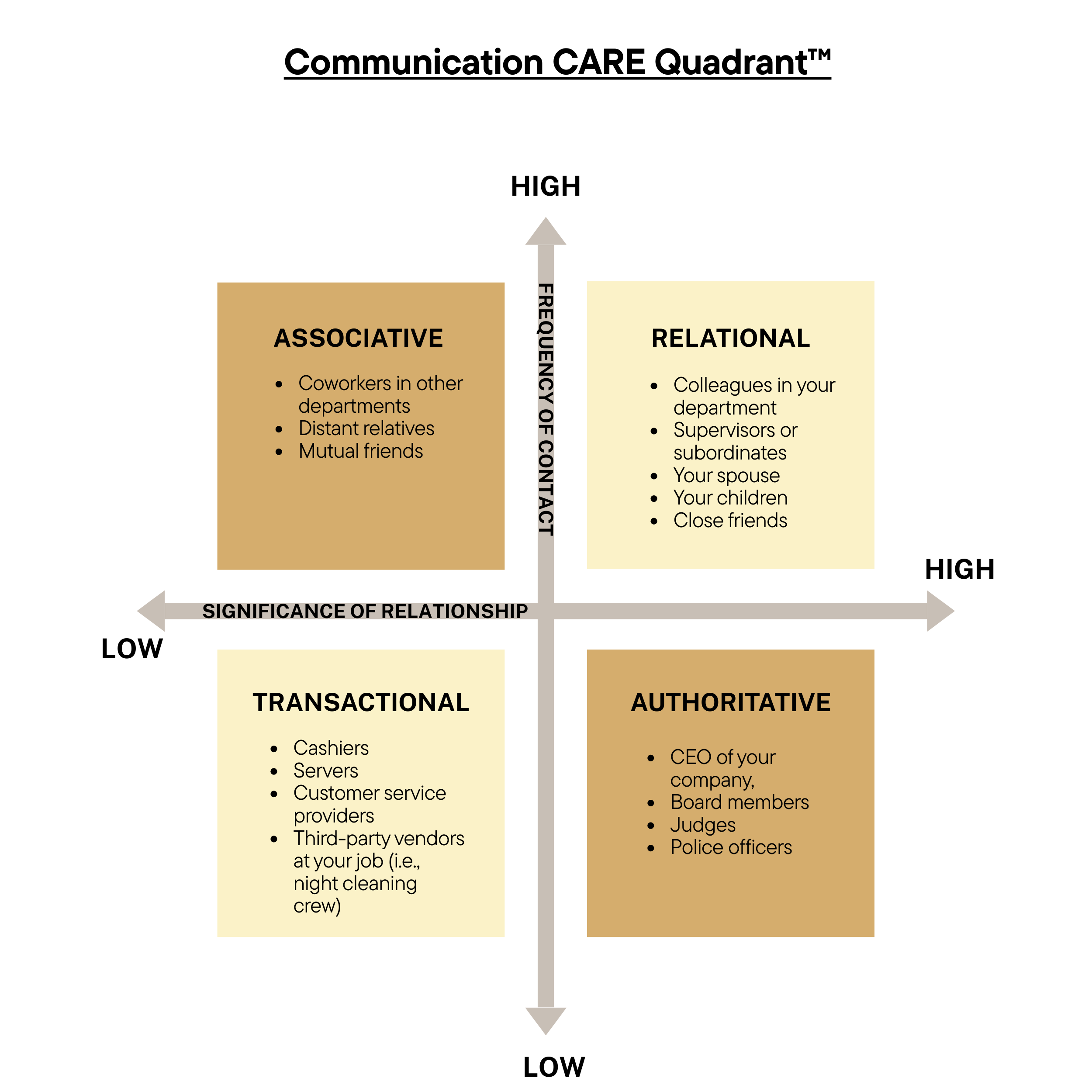
Communication CARE Quadrant™
1. Use the Communication CARE Quadrant™
Over the past year, we’ve been using the Communication CARE Quadrant™ to help individuals and teams assess when and how to engage in dialogue. The quadrant is built around two dimensions:
X-axis: Significance of the relationship (low → high)
Y-axis: Frequency of contact (low → high)
This creates four distinct relationship types:
Top Left: Associative
Top Right: Relational
Bottom Left: Transactional
Bottom Right: Authoritative
Before engaging in a conversation, especially a difficult one, ask yourself: Is this relationship significant enough, and do I interact with this person frequently enough, to make this dialogue worth the emotional energy?
For example, are you likely to have a reasoned exchange with a cashier over a controversial issue? Probably not. But a meaningful conversation with a close friend, coworker, or family member could be worth the effort. The CARE Quadrant™ helps determine if and how you engage.
It’s also a valuable tool for understanding power dynamics. If you’re in a subordinate role, timing matters—sometimes “choosing your battles” is really about choosing the right moment to speak.
2. Social Media: Accountability in the Digital Age
Social media has blurred the line between opinion and fact. The absence of physical presence can create a false sense of boldness, where people say things online they’d never say face-to-face. But accountability doesn’t disappear behind a screen.
Platforms like X, Facebook, and TikTok have become echo chambers of outrage, where performance often replaces purpose. Before posting or commenting, ask yourself: Is my intent to connect—or to convince? If your goal is to “prove a point,” you’ve likely missed the mark.
Also consider your digital legacy. What story will your posts tell about you five years from now, or when your children or grandchildren stumble across them? (For the record, my kids once found my old Myspace account and now Google me regularly!)
Remember, communication online lacks the nuance of tone, body language, and context—all of which are essential to understanding. Civil discourse can exist on social media, but it requires intentionality, restraint, and humility.
3. Check Your Assumptions
Our brains are wired for shortcuts. When we encounter beliefs that challenge our own, we often jump to conclusions without pausing to process. This is where civil discourse invites us in.
Instead of reacting from a place of defense, we can choose curiosity. Ask yourself:
What might this person’s experience be teaching me?
Is it possible there’s more than one right way to see this issue?
You don’t have to abandon your beliefs to listen. But you might begin to see people more fully, and that’s where growth happens. Civil discourse is less about changing minds and more about opening hearts.
4. Listening as an Act of Service
Listening is both a skill and an art form. Being fully present with someone who thinks, lives, or believes differently from you is one of the most powerful demonstrations of empathy.
True listening involves two dimensions:
Expressive skills: Clearly communicating your viewpoint, asking curious questions, and maintaining an open mind (“I could be wrong” is a powerful phrase).
Receptive skills: Listening without interruption, practicing cultural humility, and validating others’ perspectives—even when you disagree.
Listening may be the most consequential act you can take in civil discourse. It’s not passive, it’s active engagement in understanding another human being.
In Closing
Civil discourse is a lost art, but it’s not a lost cause. In a culture that rewards volume over value and emotion over empathy, be the calm in the chaos.
Be the reminder that disagreement doesn’t have to mean disrespect. That strength is found not in shouting the loudest, but in holding space for difference.
I long for a time when reminders about basic human decency and dignity aren’t necessary, but until then, I invite you to join me in restoring the power of civil discourse. Let’s create spaces that welcome differing views, give and demand respect, and remind us of our shared humanity.